AI AML Screening Agent: Every decision has its reason on record
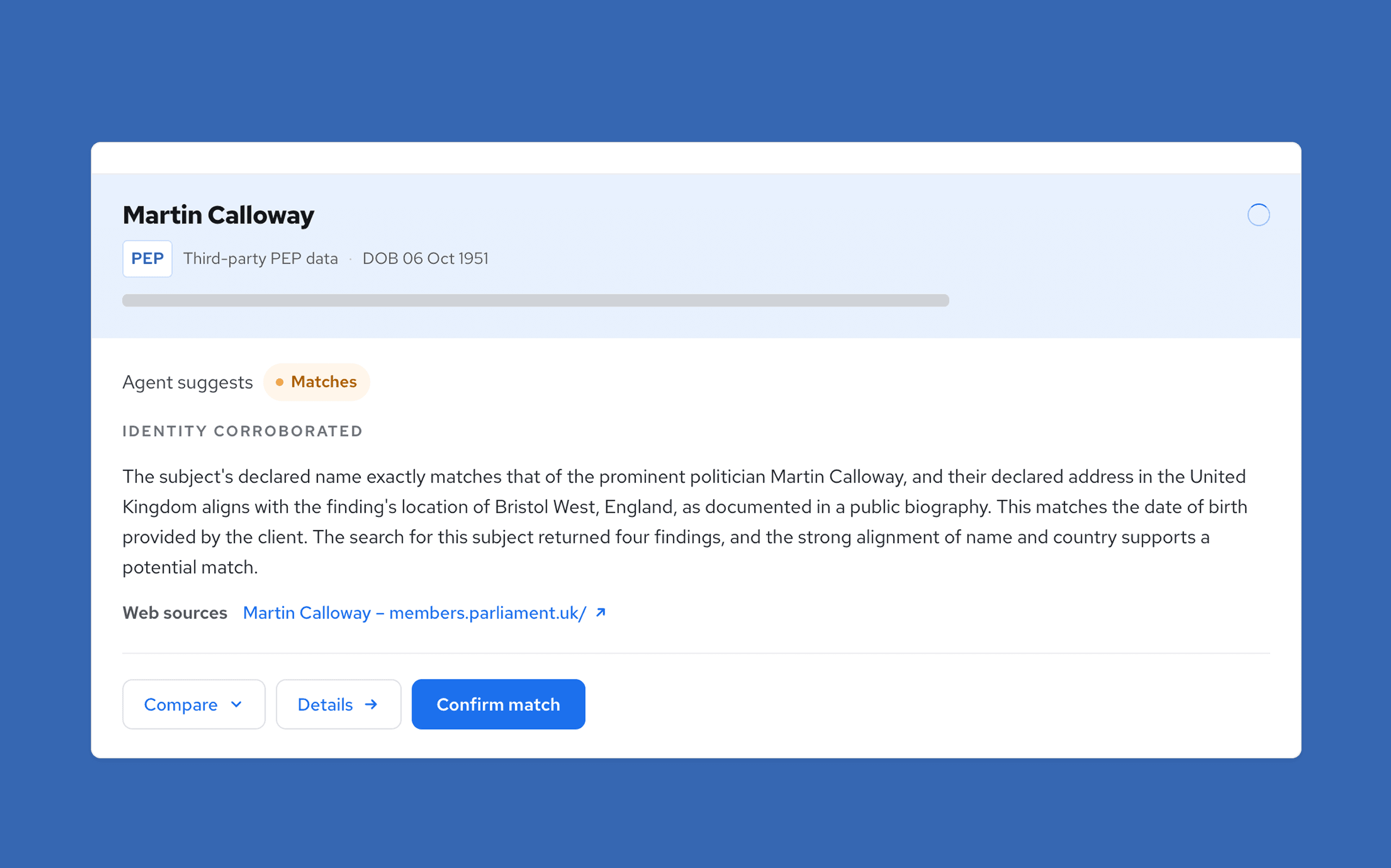
Reviewing potential anti-money laundering (AML) screening hits is no one’s favourite job. Even strong teams leave some hits unreviewed or produce reviews of inconsistent quality. How clear would the rationale for confirming or dismissing a hit be if you checked a file from six months ago? Thirdfort's Screening Agent is here to help with that.
Why an agent suits reviewing screening
Reviewing potential screening hits is repetitive, manual work that requires comparing data points, using open-source information and documenting what has been checked and why. By their nature, these hits can appear at any time. All of this is why an agent is good at reviewing screening hits.
It can quickly compare facts. An agent can compare various data points and complete follow-up research where necessary in a fraction of the time it would take a person who is switching context. Typically it takes the agent about 35 seconds from when it picks up a hit to review it.
It researches beyond the identity record and cites its sources. Where the identity record alone does not settle it, the agent searches news reports, corporate filings and other public records, and cites what it found.
It has your policy to hand at all times. The agent uses the policy you provide to guide its assessments.
It works 24/7. Whenever a hit is flagged, it will start work, even outside of working hours.
It knows what it doesn’t know. When the facts do not settle a hit, it says so and hands it to a person. The person starts from a set of facts, rather than from scratch.
Every screening decision has its reason on record. The agent will document what it checked, what it’s been able to confirm and its reasoning on every record.
A group of clients have used the agent on nearly 2,000 screening hits from live matters. They agreed with its recommendations to dismiss hits in 99.9% of cases. In 93.2% of hits, they accepted its reasoning without changing a word.
How it works
The system around the agent is as important as the agent itself. Here we discuss how you give the agent context, how the agent operates and the governance and controls that are in place to allow you to show that you are checking the work.
Giving the agent context
Just as you would give a colleague additional context to help them to review potential hits, you need to give the agent that context.
You can give the agent background about your organisation to help it interpret findings, including the services your firm offers, where you are based and the clients you serve.
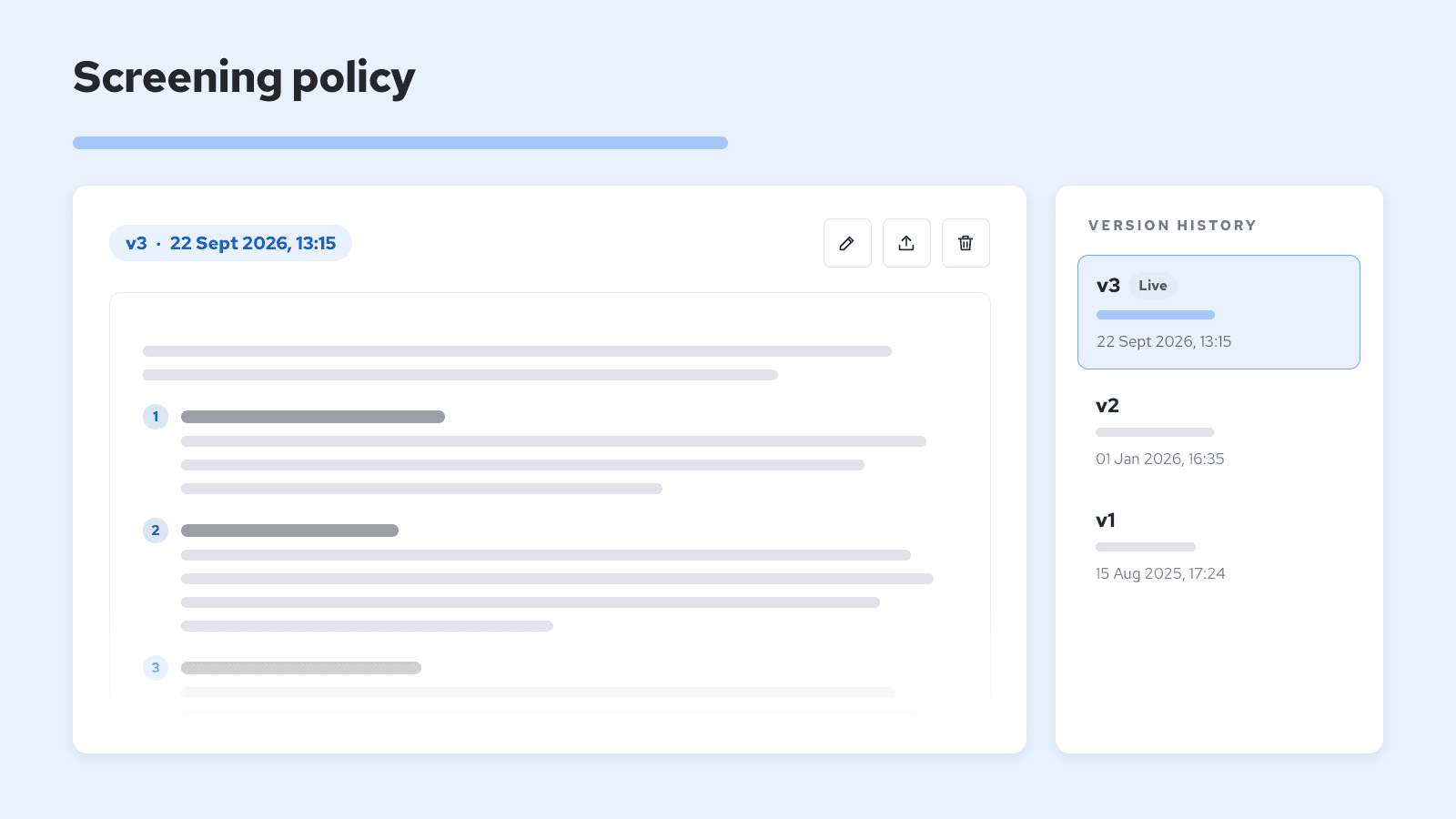
You can also give the agent your policies to help guide it. The agent will refer to this context whenever it is completing a review. If you update your policy, we track the version history, so you can see which policy was in place when.
 How the agent operates
For each potential hit, the agent compares your client’s verified name, date of birth, nationality and address with the hit profile. It applies your firm’s screening policy and researches public sources where more evidence is needed, such as Companies House records and other public records. The agent cites what it found, and says so plainly when a search turns up nothing useful. That research is used to resolve the potential hits; it does not change what your provider screens against.
The agent operates in two modes. We recommend starting by reviewing every decision the agent recommends. In this mode, the agent makes no decisions. It researches each hit, documents its thinking and makes a recommendation.
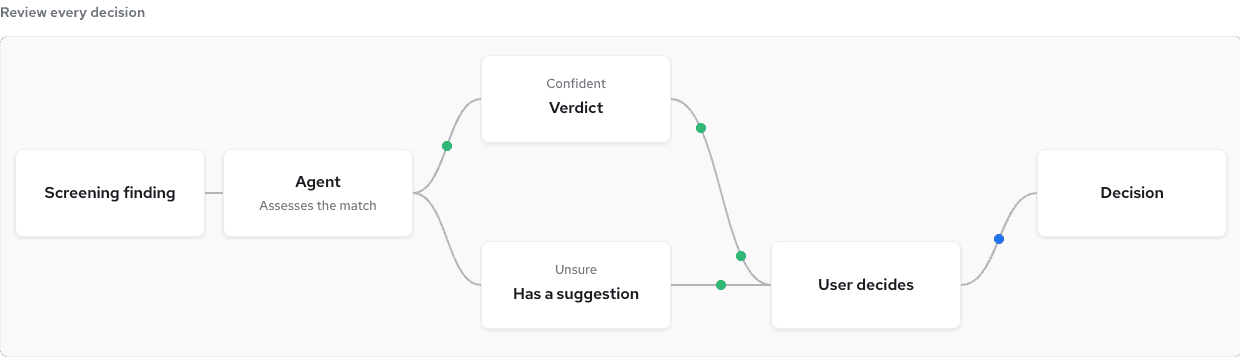 Settings can be changed so you only need to review when the agent is unsure, or believes the hit is a positive match. In this scenario, the agent will dismiss any hits it is confident do not relate to your client. Whenever it believes the hit relates to your client, or it is not confident either way, its recommendation will be sent to you to make the decision.
 Governance and controls
You need controls in place to manage your agent. We’ve built this into the system from the start.
You’ll get detailed analytics showing the number of checks reviewed by the agent, how often it has a confident verdict, what has been escalated and ultimately what decisions have been made. This live dashboard ensures you’re always up to date with how your agent is performing.
If your settings are updated to review only when the agent is unsure or believes it is a positive hit, you can carry out automatic sampling of the agent’s decisions. At a cadence that suits you, a random sample of the agent’s decisions will be sent to you for review. The results of your review of this sample will be captured, giving you an audit log of the checks you have carried out.
Worked examples
How does the agent work in practice? Below are some examples of how the agent operates.
Example 1: a councillor with the same name
A client with a common two-part name completed a check, which returned a potential hit on a local councillor of the same first name and surname. The hit was linked to the client by name alone, which the agent flagged as a weak link. Through news reports and corporate filings, the agent found that the councillor had a different middle name and was born in 1967, whereas the client was born in 1977, a date verified against the client’s identity verification. The agent noted that both people being based in the United Kingdom did not uniquely connect them, that the finding contained no other identifying detail pointing to the client and dismissed the hit with that reasoning on the record. Reaching the same conclusion by hand would have meant locating the councillor's company filings and cross-referencing dates of birth.
Example 2: a near match
A check on a subject with an uncommon name returned a warning hit on a person with a name that differed by a single letter, named in a published Court of Appeal judgment on serious criminal offences. The agent flagged the name as close but not exact, and noted that the hit carried no gender, nationality or exact date of birth. It then ran web research and found the judgment itself, which gave the person’s date of birth as a month and year only and said which county she lived in. Press reports from the time of sentencing gave her age, which fitted. The subject’s submitted date of birth fell in the same month and year, and their address was in the same county. The agent treated the one-letter spelling difference as minor, since the hit’s spelling matched the judgment exactly. It suggested a match, and put its reasoning on the record. It also recorded the gaps. The suggestion is waiting for a compliance reviewer to accept or reject it, and nothing has been decided yet. Reaching the same position by hand would have meant finding the judgment, reading it for the date of birth and location, cross-checking press coverage for her age.
Every screening decision should have its reason on record, and your team’s time should go on the hits that need expert judgement. The Screening Agent brings both together, with you in control of how far it goes. We’re onboarding the first businesses personally. Get in touch and we’ll get you set up.
Lets get your personal agent set up
We're onboarding the first businesses personally. Confirm your interest and we'll walk you through how the agent works and answer any questions you've got.
Subscribe to our newsletter
Subscribe to our monthly newsletter for recaps and recordings of our webinars, invitations for upcoming events and curated industry news. We’ll also send our guide to Digital ID Verification as a welcome gift.
Our Privacy Policy sets out how the personal data collected from you will be processed by us.