Agents of change: the risks, reality and rules of AI in compliance
Last update
With changes announced to who will regulate firms, the increasing use of artificial intelligence (AI) by clients and the continued rise in fraud in the UK, the work compliance professionals do to protect their firms and society at large continues to be vital but challenging. To better understand today’s landscape, we surveyed 200 senior compliance leaders across the legal and property sectors in the United Kingdom.
This report reveals that compliance leaders are still struggling to protect their firms, with small teams and long hours. Firms have started to adopt AI and are thinking deeply about how to govern its usage. Once again compliance professionals are on the front line protecting their firms in a rapidly changing landscape.
63%
work overtime on anti-money laundering (AML) every week
98.5%
are exploring, trialling or using AI in client due diligence (CDD)
36%
expect AI to be central to their compliance work within two years
The pressure on compliance teams
Thirdfort’s 2025 report, The compliance paradox: Small teams, big demands, shone a light on the extreme pressures that compliance teams are under. That hasn’t changed, but there are positive signs that budgets and the size of compliance teams will increase.
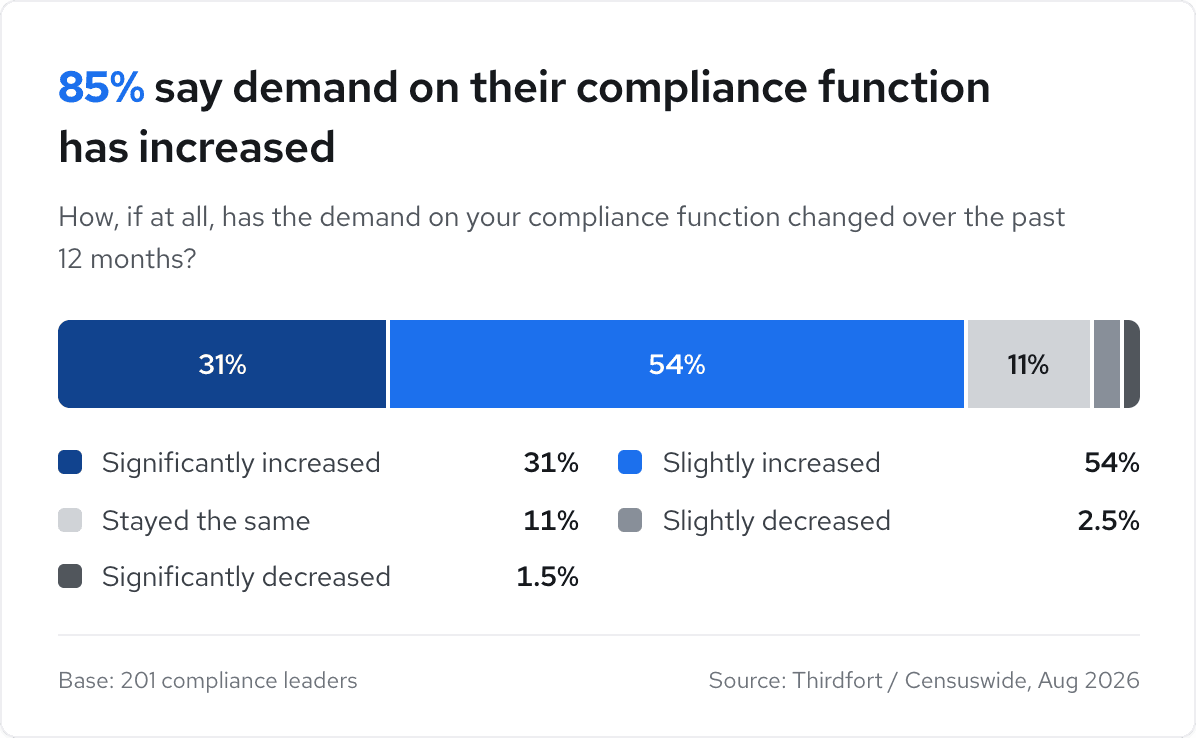
A year on, 85% of respondents told us that demands on compliance teams have increased in the past 12 months and 63% said that they worked overtime at least once per week to handle AML-related issues, up from 42% in 2025. That paints a picture of a function that's still under-resourced.
 Perhaps, though, the tide is turning.
In last year’s report, 31% of respondents told us that they expected budget cuts in the next 12 months. However, this year only 5.5% expect a decrease in their budget and 61% are planning for their firm’s AML budget to increase in the next year.
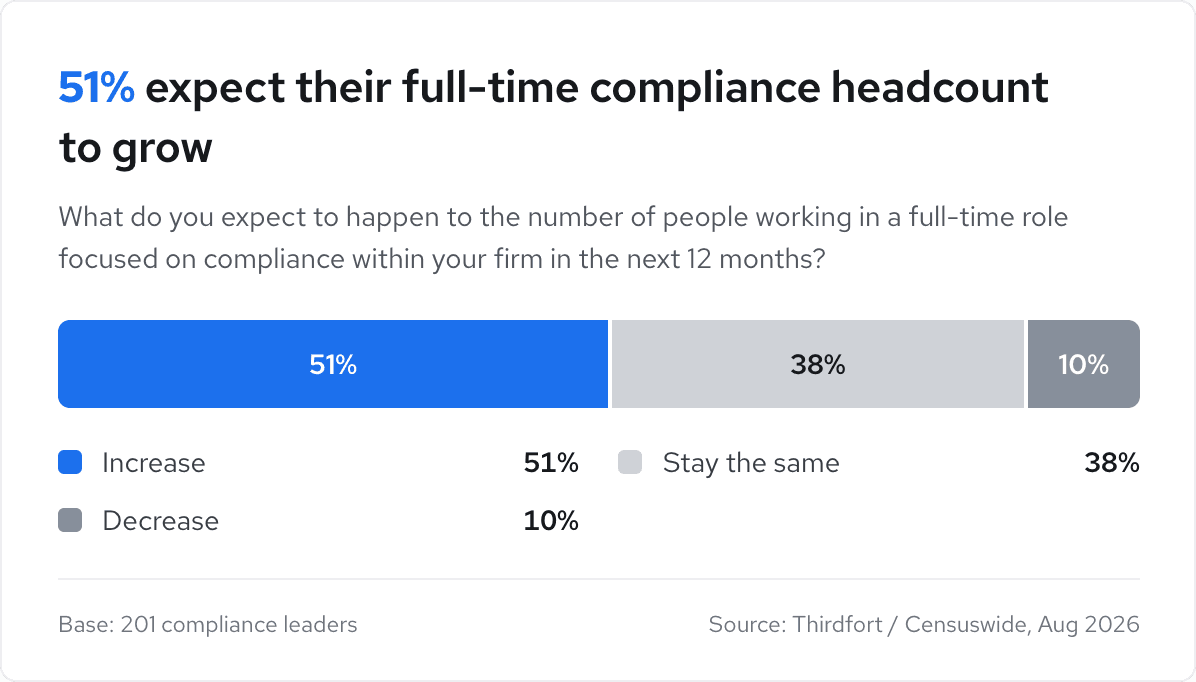
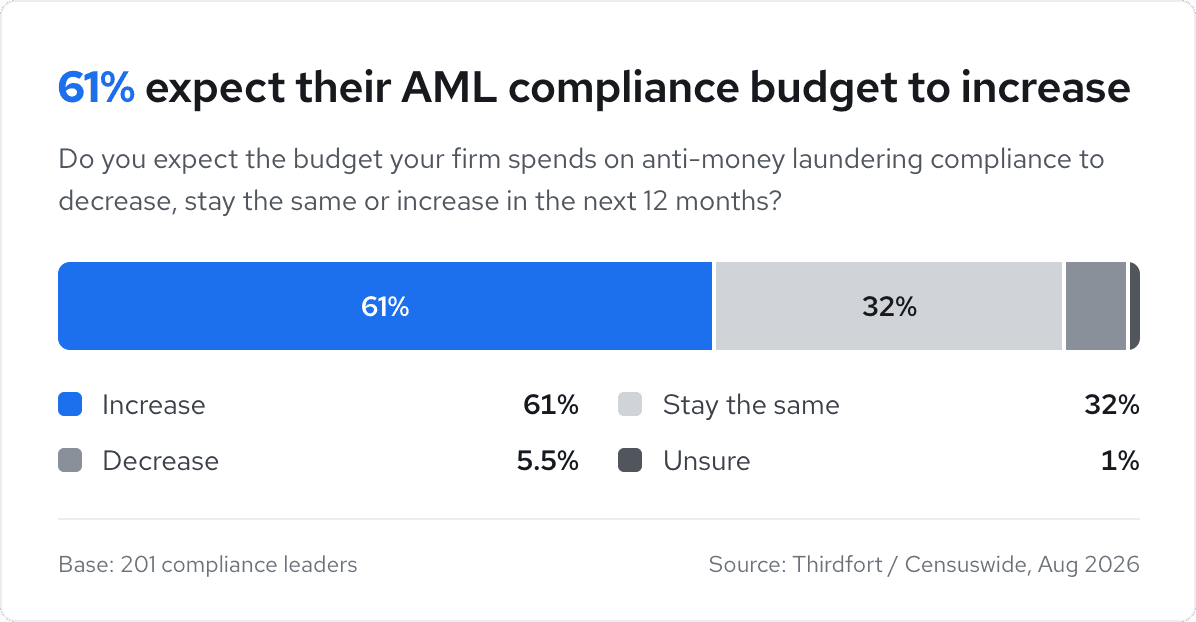 Those budget increases are likely to come in the form of increased headcount, with 51% of respondents believing that the size of their compliance team will increase, compared with only 26% that were surveyed last year, suggesting that help is on the way for many senior compliance professionals.
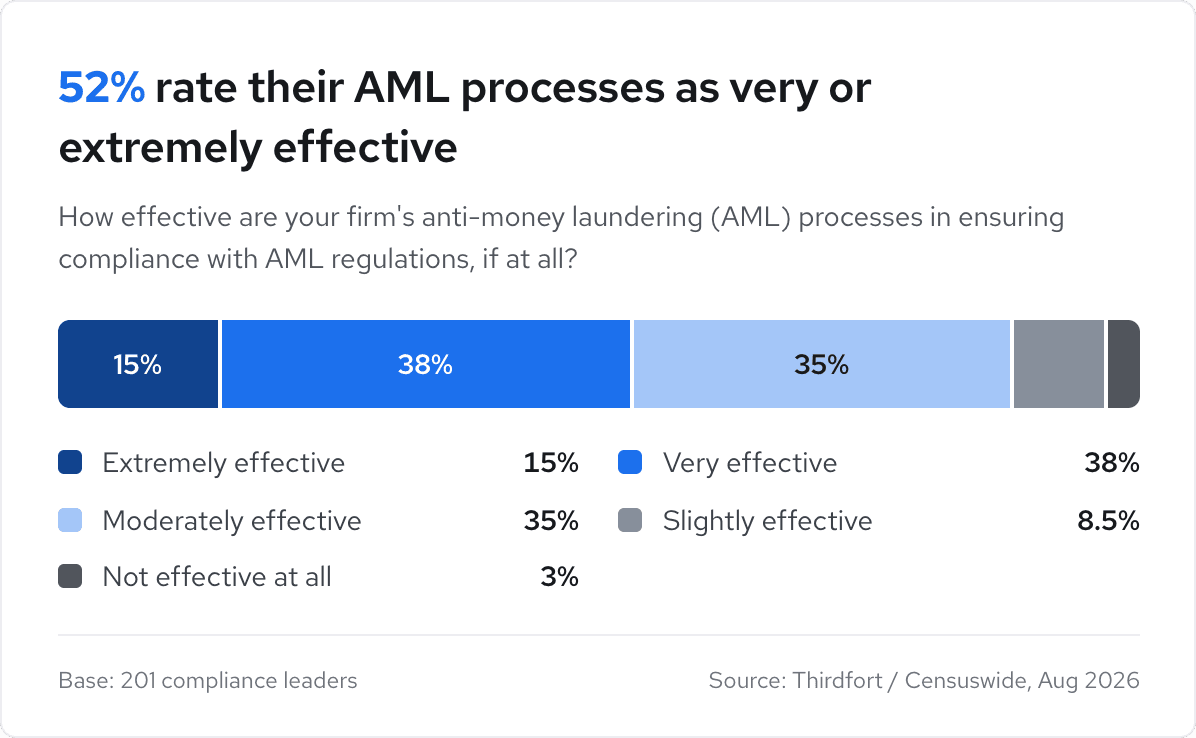
 The positive news goes beyond resourcing. It extends to how effective compliance leaders believe their AML processes are in ensuring compliance with AML regulations. 52% believe their current processes are extremely or very effective in ensuring compliance. Interestingly, smaller firms (1-25 people) are more likely to believe their processes are extremely or very effective than larger (more than 150 people) firms (59% vs 46%).
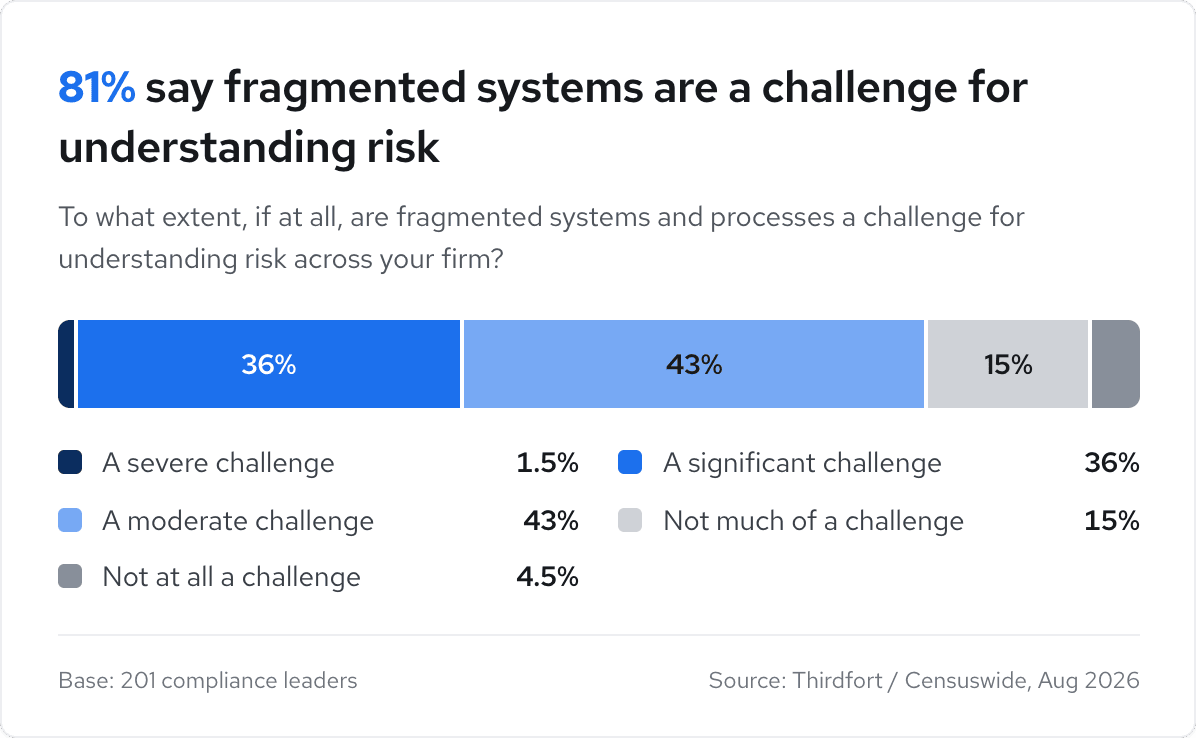
 So why aren’t these numbers higher? Well, one of the challenges identified in the survey was fragmented systems.
When systems and processes are fragmented it can feel like you’re holding everything together by your fingertips. 81% of senior compliance professionals surveyed described this as a live challenge they face today. It’s one that unfortunately is unlikely to be fixed by increasing headcount.
AI adoption: The state of play
If the leading AI companies such as Anthropic and OpenAI are to be believed, AI will completely change the world of work within the next few years.Some roles have already been drastically impacted.
So how is AI being used today in law firms and estate agencies?
The compliance professionals we surveyed told us that today firms are still working out what works. 68% of respondents said that their firm was still in an early phase of research, trials and exploration into how client due diligence processes (CDD) could be transformed with AI, with only 5.5% embedding it across their workflows.
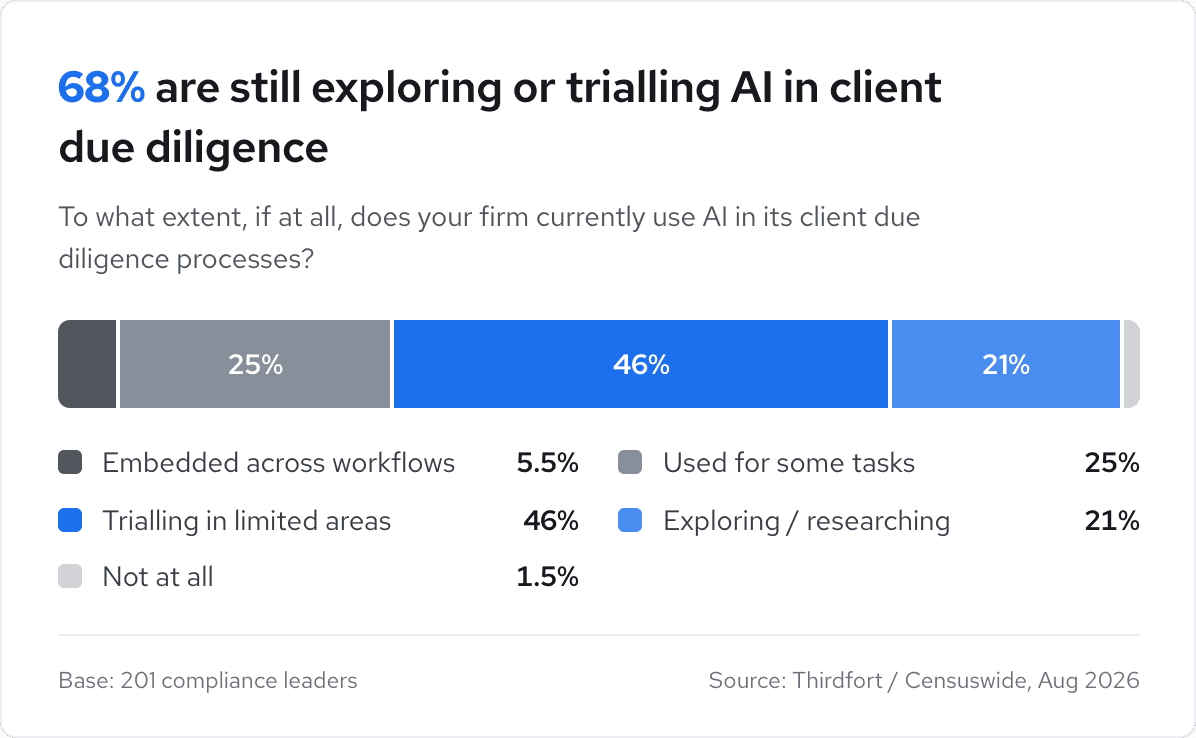 If you’re worried you’re being left behind, you’re probably not, unless you are part of the 1.5% who told us they are not using AI at all. Clearly adoption is still at an early phase.
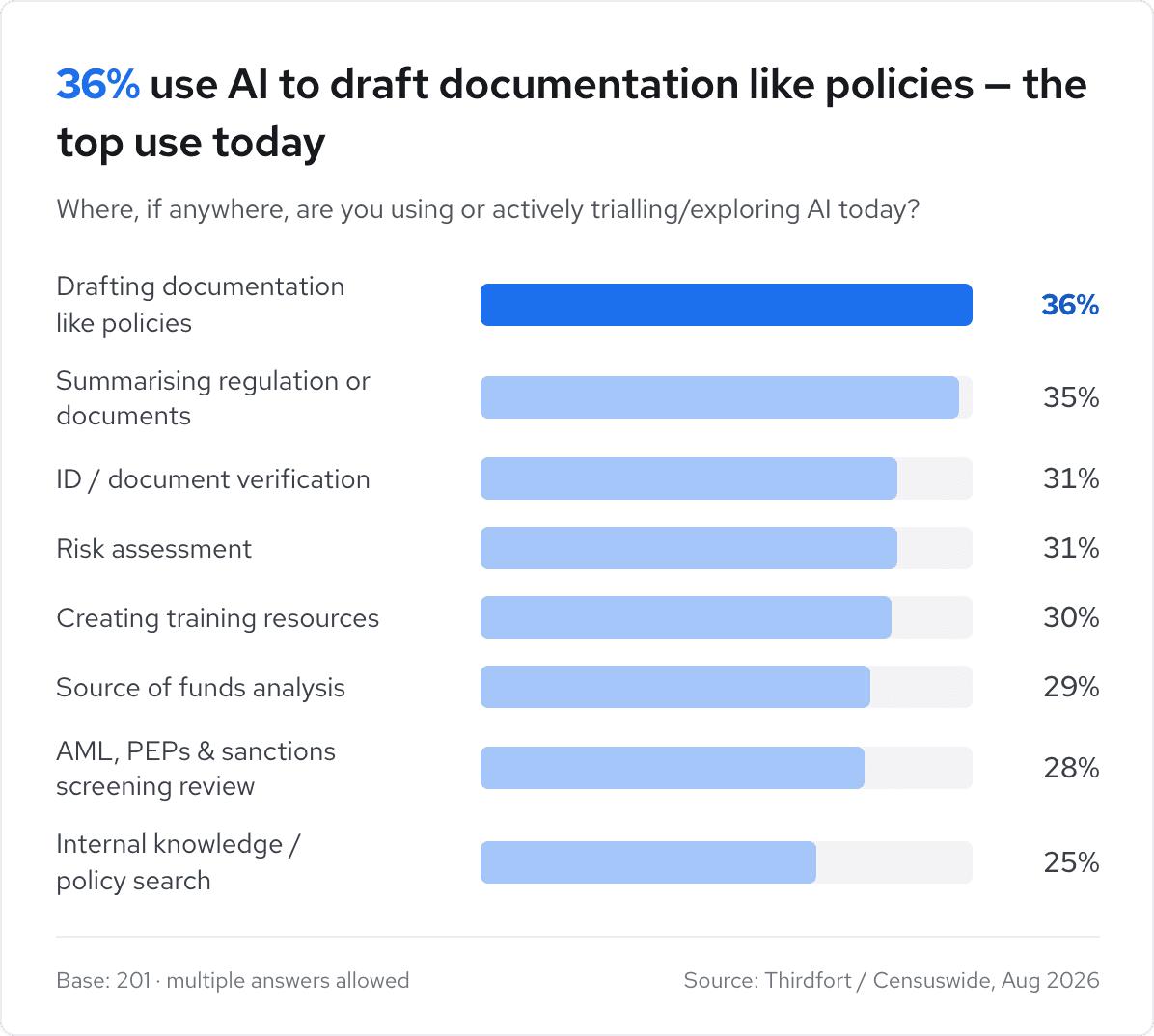
To understand this further, we asked respondents to tell us where they are using AI today. The answer is across a wide range of activities. The most common uses are ‘Drafting documentation like policies’ (36%), ‘Summarising regulations or documents’ (35%), ‘ID or document verification’ (31%), ‘Risk assessment’ (31%) and ‘Creating training resources’ (30.35%). These responses suggest that as it stands, AI is mainly being used to create or complete documentation and machine learning is used to detect fake documents.
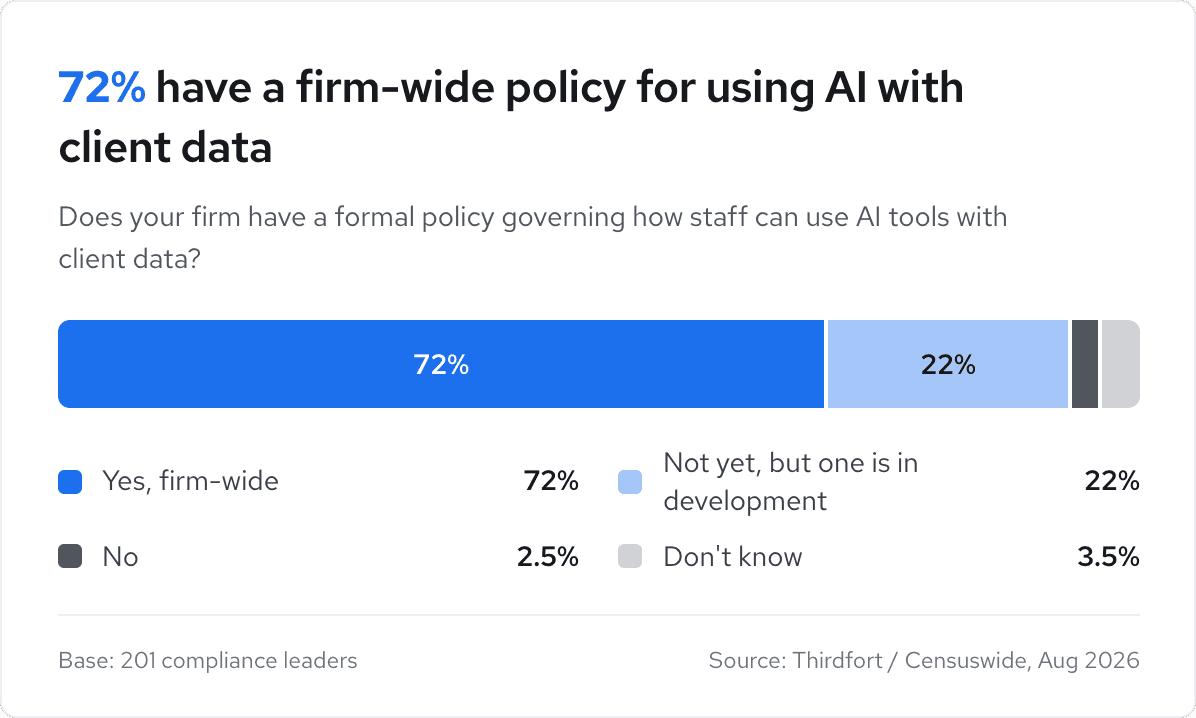
 As compliance teams start using AI in CDD, governance and training come into focus.This is where compliance professionals have already taken action. 72% of senior compliance professionals surveyed told us their firm has a firm-wide policy which governs how staff can and should use AI with client data, with only 2.5% telling us that they do not have a policy and that they are not currently developing one.
 Given that many firms already have policies in place, why isn’t AI being used more to take the legwork out of CDD?
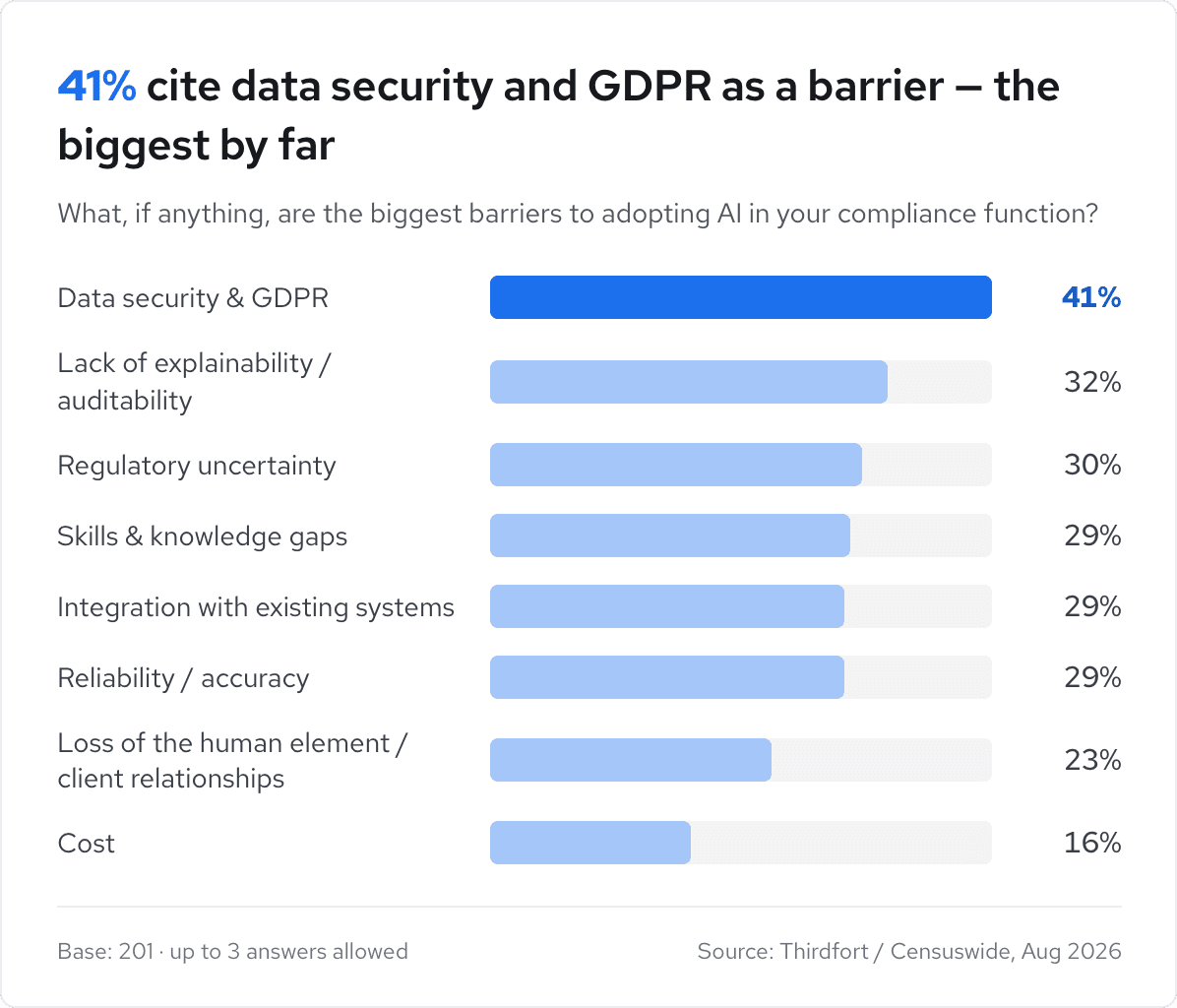
We wanted to see what the top three barriers to adopting AI within compliance functions are. What we discovered was that there are many issues holding adoption back, with the biggest being ‘Data security and General Data Protection Regulation (GDPR)’, ‘Lack of explainability and auditability’, ‘Regulatory uncertainty’ and ‘Skills and knowledge gaps’.
What compliance leaders want from AI
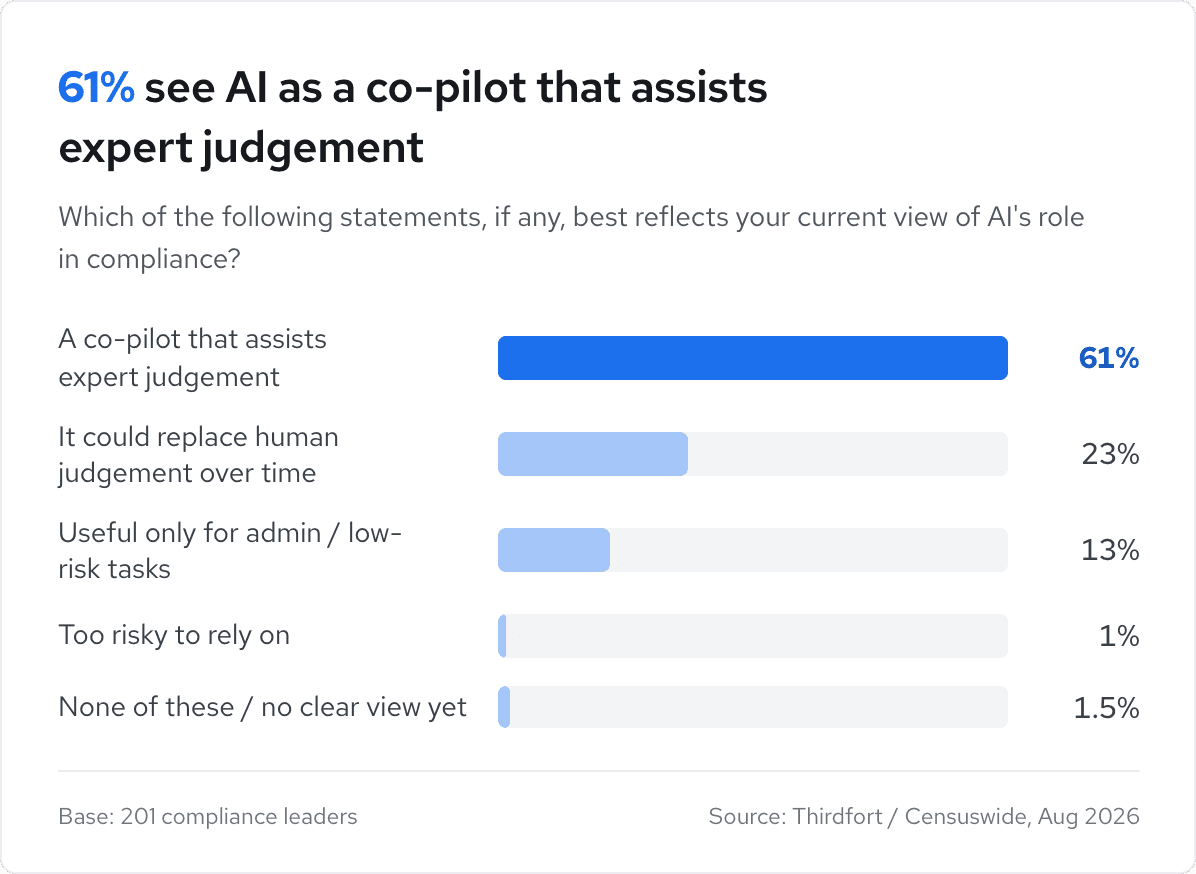
Given the pressures on compliance professionals uncovered in this report, it feels natural that AI would be considered as a way to reduce the workload. But how do compliance professionals think AI might help them today? We asked their current view on AI’s role in compliance. Nearly two-thirds (61%) feel that AI is a co-pilot that assists expert judgement, compared with only 23% believing it could replace human judgement over time. Perhaps surprisingly, just 13% feel it is only useful for admin or low-risk tasks.
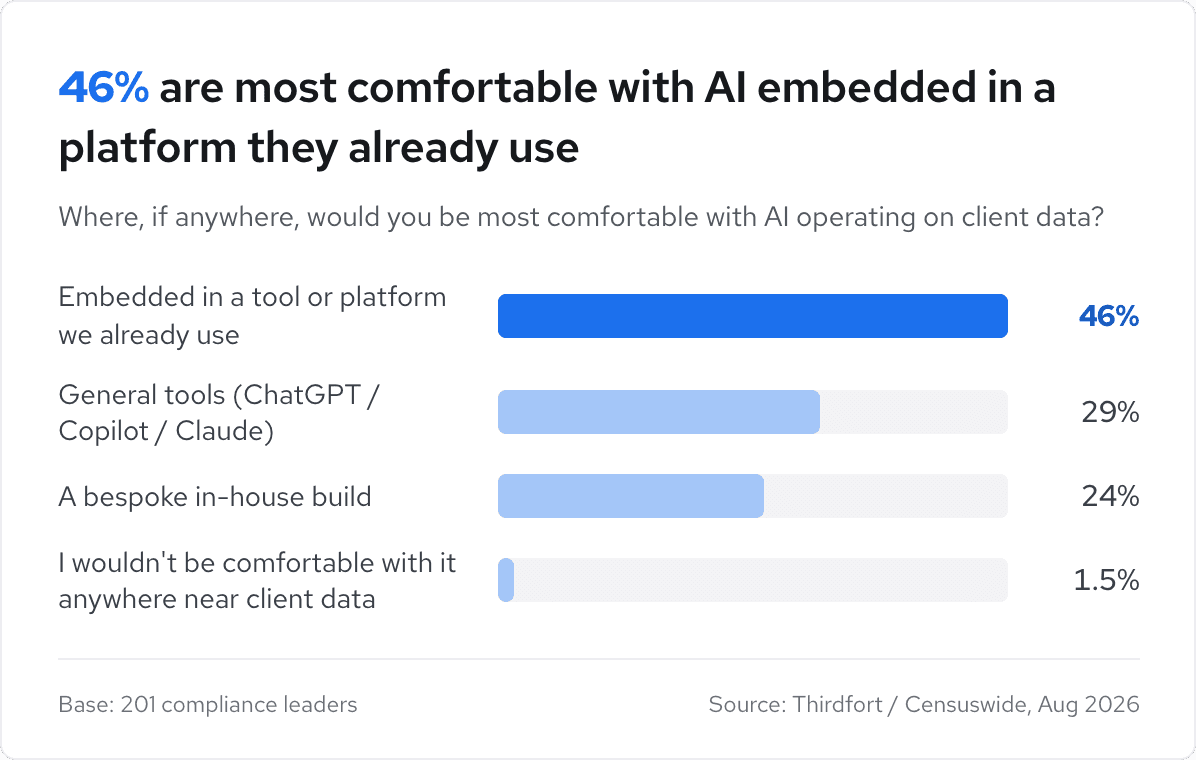
 For AI to become a co-pilot that can assist compliance teams, it needs access to context and data. To give it that context, it needs to work within a system that holds the data, which raises the question of where that system should be. We asked survey respondents: “Where, if anywhere, would you be most comfortable with AI operating on client data?” 46% told us that they would feel most comfortable with it embedded in a tool or platform they already use, 29% with general tools like ChatGPT, Claude or Microsoft Copilot and 24% in a bespoke in-house build.
 This aligns with the barriers to adoption including data security and skills and knowledge gaps. If AI is operating in a system you trust and understand, it’s easier to get on board.
Are there those who will not trust AI to operate on client data? Of course. But according to our survey they are very much in the minority, with just 1.5% telling us they wouldn’t be comfortable with allowing AI anywhere near client data.
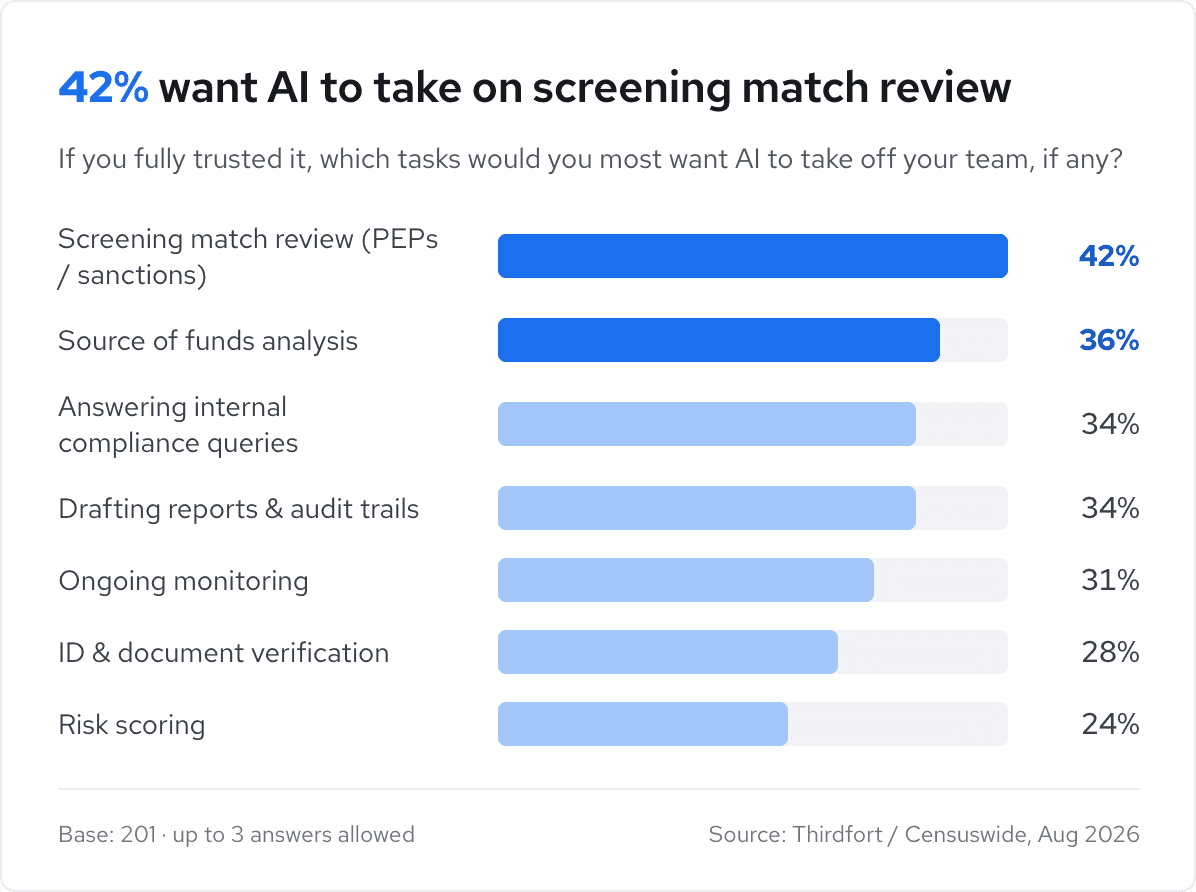
The need and enthusiasm for using AI in CDD processes is evident, but in what capacity? If trust was a given, which tasks would compliance professionals most like AI to take off their team? We asked respondents to select up to three. Whilst today AI is mainly being used to create and complete documents, compliance leaders are looking for AI to take a more active role in reviewing client information in the future. 42% are looking for assistance with AML screening match reviews and 36.% would like help with source of funds analysis. These are vital parts of the CDD process that go far beyond drafting a document it is where expert judgement is required, but it still remains incredibly time-consuming.
A look to the future
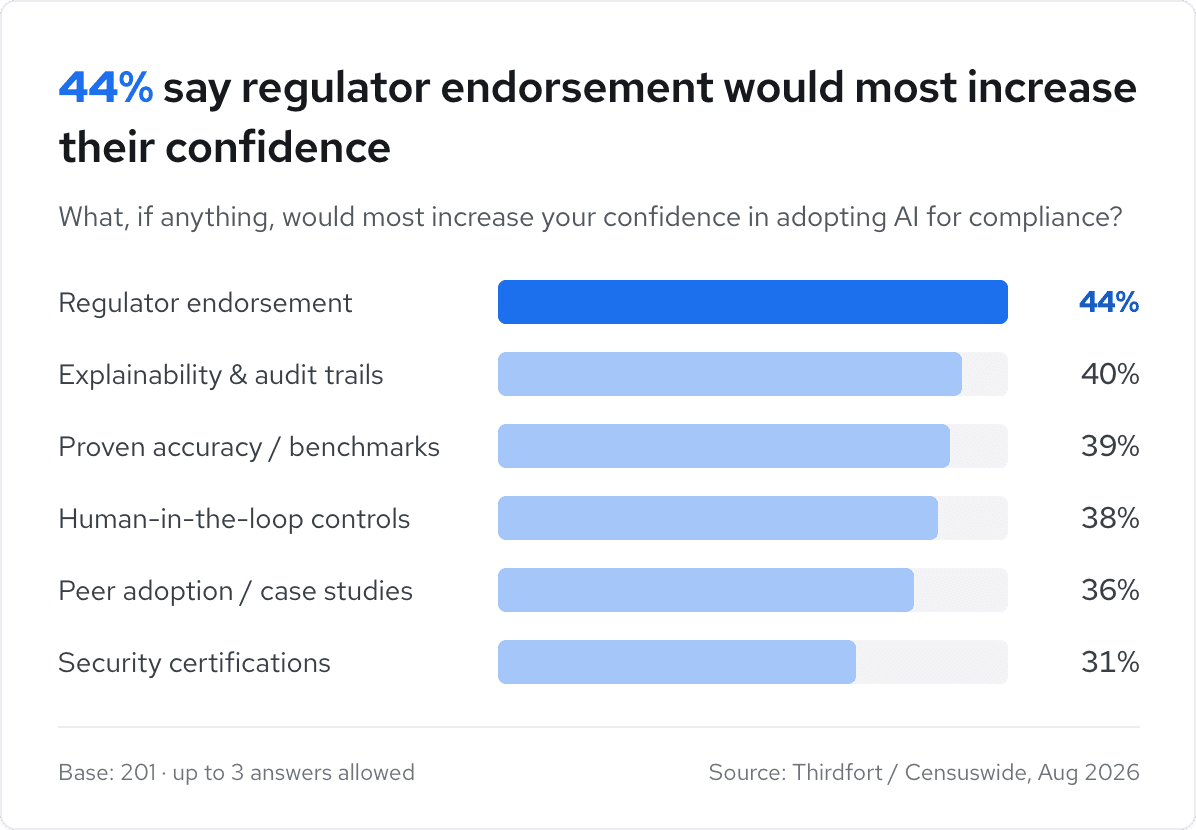
How can the industry push forward with adopting AI in order to release the pressure on compliance functions? It’s a tricky and nuanced topic. It’s one where confidence in the solutions can only help. To understand what would give that confidence, we asked ‘What, if anything, would most increase your confidence in adopting AI for compliance?’ The most important change would be endorsements from the regulator, followed by ‘explainability and audit trails’, ‘proven accuracy/benchmarks’ and ‘human-in-the-loop controls’.
 The industry does expect to overcome these barriers. When asked ‘In two years, what role, if any, do you expect AI to play in your compliance function?’ 50% said it would assist on specific tasks and 36% expect it to become central to most workflows.
Conclusion
There is a long, exciting road ahead when it comes to AI adoption in compliance.. Compliance leaders are telling us the pressure hasn't let up in their efforts to protect their firms and whilst there are very positive signs in terms of budgets and resource, technology and particularly AI has an important role to play in releasing the pressure valve.
Today, very few teams are consistently embedding AI into their workflows, but the professionals on the front line believe there are opportunities to change that. They are looking to go from AI helping them to draft materials, to AI that can be a co-pilot that assists in more complex tasks like AML screening reviews and source of funds analysis.
To get there in the next two years better guidance from regulators would be welcome, but it also requires partnering with providers who can be trusted and who look to make explainability and auditability central to their product.
The report at a glance
The headline findings from our survey of 201 senior compliance leaders, in brief.
Subscribe to our newsletter
Subscribe to our monthly newsletter for recaps and recordings of our webinars, invitations for upcoming events and curated industry news. We’ll also send our guide to Digital ID Verification as a welcome gift.
Our Privacy Policy sets out how the personal data collected from you will be processed by us.